

General Information
Central Oversight
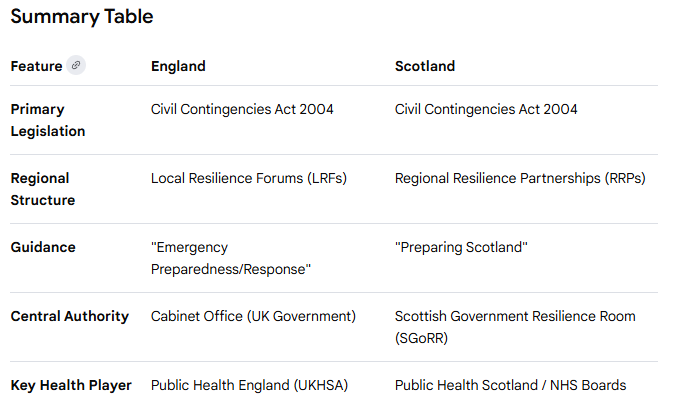
In Scotland, the Scottish Government holds devolved responsibility for civil contingencies and manages its own Scottish Government Resilience Room (SGoRR)
Strategic Coordinating Groups (SCGs)
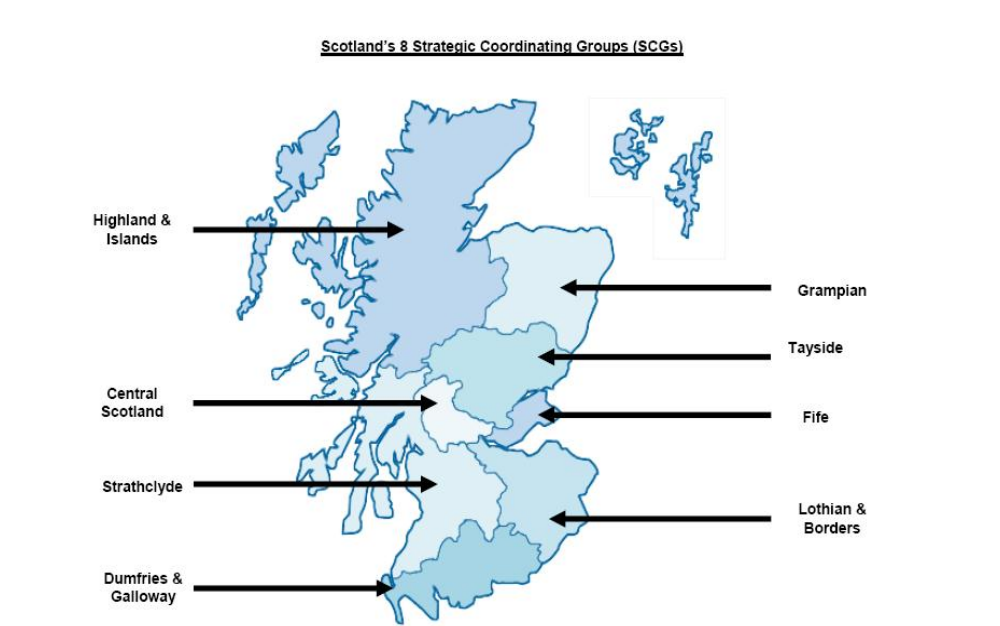
Strategic Coordinating Groups (SCGs) in Scotland are multi-agency partnerships that form the backbone of local emergency planning and response, bringing together emergency services, local authorities, health boards, and other agencies to manage major incidents. Under the Civil Contingencies Act 2004 and related Scottish regulations, SCGs are responsible for coordinating the strategic response to crises, such as severe weather, floods, or major accidents.
The integrated emergency planning structure in Scotland is co-ordinated through eight, multi-agency Strategic Co-ordinating Groups (SCG) that are aligned with the boundaries of the eight Scottish police force areas.
Regional and Local Resilience Partnerships (RRPs / LRPs)
Regional and Local Resilience Partnerships (RRPs/LRPs) are the principal mechanisms for multi-agency co-ordination under The Civil Contingencies Act (2004). They promote co-operation between organisations in preparation for and responding to national emergencies. A Resilience Partnership may be activated to deal with the wider consequences of the emergency and ensure that the multi-agency response is well coordinated and effective. Resilience Partnerships can be convened at a local level or across a wider area, depending on the nature of the incident and the organisations involved.
Key Responders
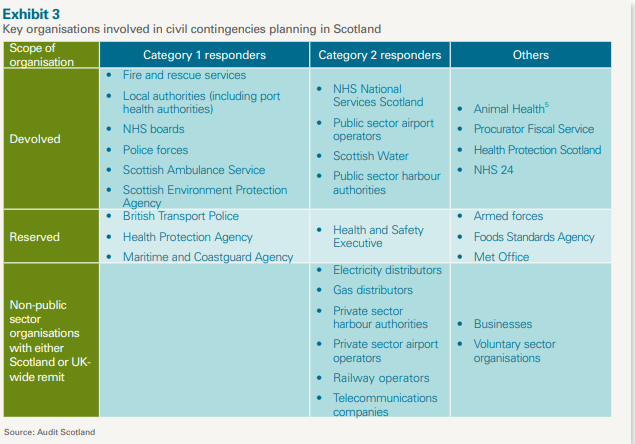
NHS National Services Scotland and Public Health Scotland are specifically designated as Category 2 responders under Scottish regulations. The Scottish Environment Protection Agency (SEPA) plays a key role.
Category 1 responders are defined in the legislation as:
- Local Authorities
- police
- fire
- ambulance
- Health Boards
- Scottish Environment Protection Agency
- Maritime and Coastguard Agency
- Integration Joint Boards
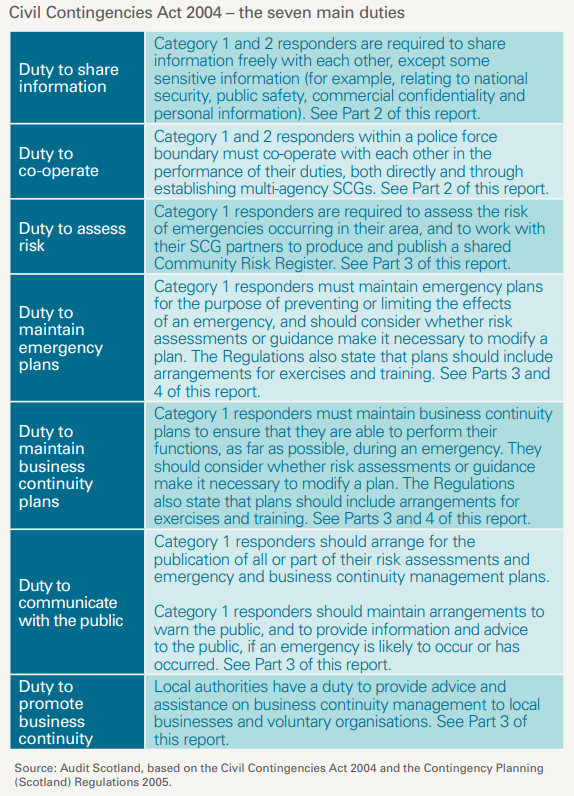
Key Responder – Main Duties
The ‘Regional Resilience Partnerships’ Risk Preparedness Assessment’ (RRP RPA)
Preparing Scotland is a suite of guidance to assist responders plan for, respond to and recover from disruptive challenges. It consists of a ‘hub’ which sets out Scotland’s resilience philosophy, structures and regulatory duties, and ‘spokes’ that provide detailed guidance on specific matters. The ‘Regional Resilience Partnerships’ Risk Preparedness Assessment’ (RRP RPA) guidance document is one of those spokes.
The RRP RPA is not set out in the legislation, rather it has been developed to assist responders discharge their duties under the Act.
Specifically, the purpose of the RRP RPA is to:
- provide an accurate and shared understanding of the risks which may affect a region based on available evidence so that consequence-based planning has a sound foundation
- provide a rational basis for the prioritisation of effort and allocation of resources
- identify and assess the capabilities and capacities (preparedness) of the region to deal with the consequences of the risks
- develop a work plan aimed at closing any identified capability (ability to deal with consequences) and capacity (resource available) gaps
- provide an overview of emergency planning and business continuity arrangements for responders and resilience partners within the region
- provide a basis for risk communication to the general public through community risk registers (CRRs)
Scottish Government Resilience Room
The Scottish Government Resilience Room (SGoRR) is the emergency and crisis response co–ordination facility of the Scottish Government, activated in cases of national emergency or crisis, or during events abroad with major implications for Scotland. It is located in Edinburgh, Scotland’s capital city, at St Andrew’s House, the official headquarters of the Scottish Government. Prior to February 2008, it was called the Scottish Government Emergency Room, or “SEER”, from the former name “Scottish Executive Emergency Room”.
When the extent or complexity of an emergency requires a greater degree of central government co-ordination, the Scottish Government will formally launch and activate its emergency response arrangements through the Scottish Government Resilience Room. The precise role of the facility will alter depending on the precise nature and matter of the emergency.
Scientific and Technical Advice Cell (STAC)
Preparing Scotland is a suite of guidance to assist responders plan for, respond to and recover from disruptive challenges. It consists of a ‘Hub,’ which sets out Scotland’s resilience philosophy, structures, and regulatory duties, and ‘Spokes’ that provide detailed guidance on specific matters. The Scientific and Technical Advice Cell (STAC) guidance document is one of those spokes.
Responders often require expert advice on a range of scientific and technical issues in order to deal effectively with the immediate and longer term consequences of an emergency. When a multi-agency response is required, this expert advice must be coordinated, and can come from a range of organisations and cover a variety of areas, such as public health, environment, animal health, water, technical failures, etc. This co-ordination can be done through the establishment of a STAC.
Support Centres
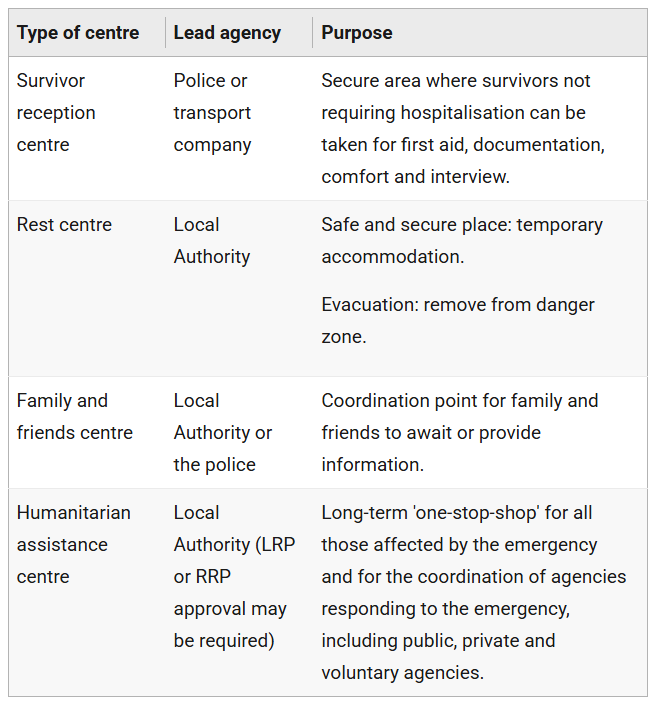
The following table provides a summary of the 4 main types of support centres typically set up during an emergency, it is recognised that some areas may also activate other types of centres.
Care for People Teams
Preparing Scotland recommends establishing a number of specialist sub-groups to drive forward work in particular areas of emergency planning.
The Care for People team is a multi-agency functional team that is active at the tactical level in preparation, response and longer-term recovery. It is one of a number of functional groups which should be established at the tactical level (for example, a Public Communications Group and a Scientific and Technical Advice Cell).
A rest centre is a safe and secure place managed by the Local Authority for the temporary accommodation of people displaced by an emergency. It may provide overnight facilities in the short term.
The Care for People team both in preparation and response should comprise of representatives from all agencies and functions with a part to play in caring for people, including: voluntary organisations – for example, British Red Cross, RVS, Salvation Army, St. Andrew’s First Aid, Samaritans, Cruise and animal welfare
Devolution
While the CCA applies to both, Scottish Ministers hold the power to make regulations and issue guidance for Scottish responders.
While the operational, boots-on-the-ground response is often similar, the legal responsibility and strategic coordination structures differ to reflect Scotland’s devolved status.
Ready Scotland
Ready Scotland is a Scottish Government initiative and a large online website providing advice, resources, and guidance to help individuals, households, and communities prepare for, respond to, and recover from emergencies. It focuses on building resilience against risks like severe weather, pandemics, and infrastructure failures, offering practical tools for emergency planning and volunteering.
Response Structures
Pandemic preparedness and response structures in Scotland – c. 2019
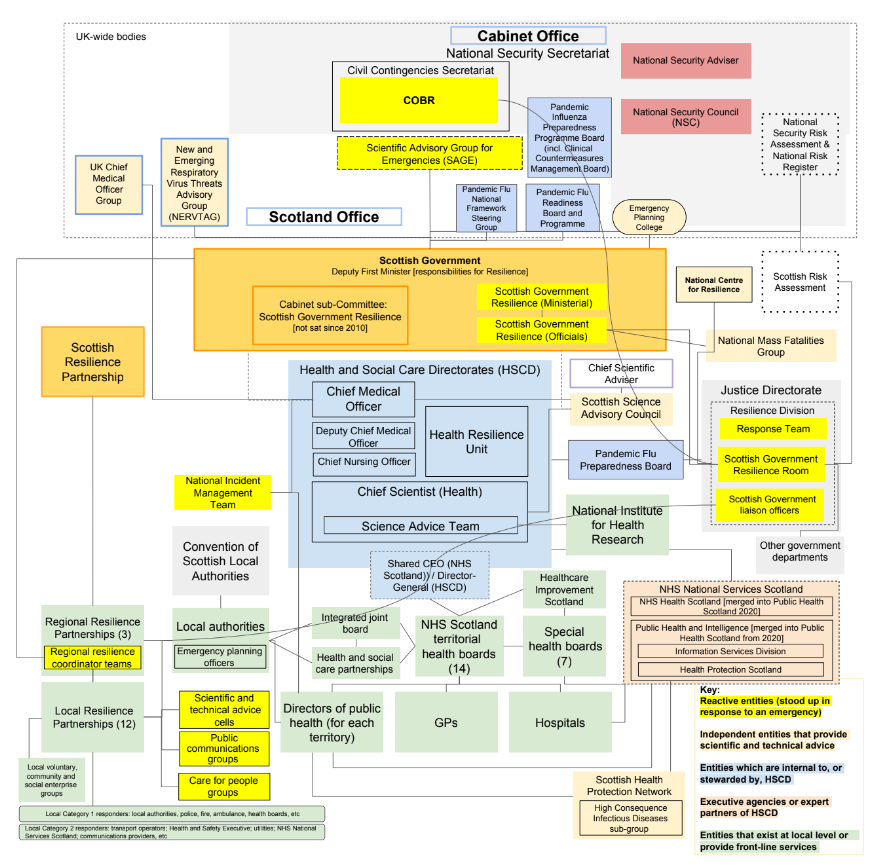
Source – INQ000204014 – UK Pandemic Preparedness Organograms, dated between 2009 and 2020
Key Documents
Responders operate under “Preparing Scotland” guidance, which is tailor-made for the Scottish landscape and focuses on resilience, risk assessment, and recovery. The guidance to support the Civil Contingencies Act 2004 (Contingency Planning) (Scotland) Amendment Regulations 2013 is known as Preparing
Scotland. Whilst frequently referenced it is now difficult to locate as it has been largely replaced with the website – Ready Scotland
- Contingency Planning: Emergency Planning & Business Continuity – Annual Report and Response to Audit Scotland Repor
- Guide to emergency planning for community groups
- Improving civil contingencies planning – Audit Scotland
- Preparing for Emergencies Guidance for Health Boards in Scotland November 2023
- Regional Resilience Partnerships – data.gov.uk
- The Moray Council Emergency Planning Policy and Procedures
- UK National Leadership for Risk Identification, Emergency Preparedness, Response and Recovery – GOV.UK
Key Legislation
Links
- Community Risk Register | Scottish Fire and Rescue Service
- The Scottish Flood Forum – Supporting Flood Risk Communities
- What role would the public and government have in civil defence? – State of Wales
- Annex B – support centres – Ready Scotland
- Building resilient communities – Ready Scotland
- Care for people affected by emergencies – Ready Scotland
- Communication and the media – Ready Scotland
- Dealing with mass fatalities in Scotland – Ready Scotland
- Emergency advice – Ready Scotland
- Emergency planning for communities – Ready Scotland
- Establishing a Care for People team – Ready Scotland
- Exercise guidance – Ready Scotland
- Guide to emergency planning for community groups – Ready Scotland
- Having and promoting business resilience – Ready Scotland
- Other legislation – Existing emergency planning duties – Ready Scotland
- Partnership working in emergency management – Ready Scotland
- Philosophy, principles, structures and regulatory duties – Ready Scotland
- Publications – Ready Scotland
- Recovering from emergencies in Scotland – Ready Scotland
- Regional Resilience Partnerships Risk Preparedness Assessment guidance – Ready Scotland
- Responding to emergencies in Scotland – Ready Scotland
- Responding to the psychosocial and mental health needs of people affected by emergencies – Ready Scotland
- Scientific and Technical Advice Cell (STAC) – Guidance – Ready Scotland
- The foundations of emergency management in Scotland – Ready Scotland
- The role of community groups in emergencies – Ready Scotland
- Warning and informing Scotland: Communicating with the public – Ready Scotland