

General Information
The Civil Contingencies Act
The Civil Contingencies Act (2004) and its accompanying Regulations and Guidance place statutory responsibilities on Category 1 Responders to
prepare for emergencies. It delivers a single framework for civil protection in the United Kingdom and is separated into two parts:
- Part 1 – Local arrangements for civil protection
- Part 2 – Emergency powers for Government
Emergency Definition
The definition of
emergency in the Act focuses on the consequences of emergencies. It defines an
emergency as:
- an event or situation which threatens serious damage to human welfare;
- an event or situation which threatens serious damage to the environment; or
- war, or terrorism, which threatens serious damage to security.
Central Oversight
In England, the Cabinet Office (Civil Contingencies Secretariat) sets policy.
Key Responders
Specific agencies like the Environment Agency (for England) and specific NHS Trusts are tailored to the English structure.
Emergency Powers for Government
The Act allows the making of temporary special legislation aimed at dealing with a serious emergency that fits within the definition. The King, as Head of State, will formally indicate that emergency powers are necessary as part of the Order in Council that makes the regulations themselves.
The Act introduces a range of other new features, mostly designed to ensure emergency powers cannot be misused and can be used in a more targeted and proportionate manner.
The centre piece of these is the “triple lock”, which ensures emergency powers will only be available if:
- an emergency that threatens serious damage to human welfare, the environment or
security has occurred, is occurring or is about to occur; - it is necessary to make provision urgently in order to resolve the emergency as
existing powers are insufficient and it is not possible to bring forward a Bill in the
usual way because of the need to act urgently; and - emergency regulations must be proportionate to the aspect or effect of the
emergency they are directed at.
In addition to emergency regulations:
- cannot prohibit or enable the prohibition of participation in, or any activity in
connection with, a strike or other industrial action; - cannot instigate any form of military conscription;
- cannot alter any aspect of criminal procedures;
- cannot create any new offence other than breach of the regulations themselves;
- must be compatible with the Human Rights Act and EU law; and
- are open to challenge in the courts
For the first time it is possible to use emergency powers on a regional and/or devolved administration basis. This ensures any special temporary legislation will apply only in the part of the UK affected by the emergency, leaving those elsewhere unaffected.
Local resilience forums (LRFs)
England primarily uses Local Resilience Forums (LRFs), which are based on police force areas to bring together emergency services, local authorities, and health bodies to plan for local risks.
Local resilience forums (LRFs) are multi-agency partnerships made up of representatives from local public services, including the emergency services, local authorities, the NHS, the Environment Agency and others. These agencies are known as Category 1 Responders, as defined by the Civil Contingencies Act.
LRFs are supported by organisations, known as Category 2 responders, such as the Highways Agency and public utility companies. They have a responsibility to co-operate with Category 1 organisations and to share relevant information with the LRF. The geographical area the forums cover is based on police areas.
LRFs also work with other partners in the military and voluntary sectors who provide a valuable contribution to LRF work in emergency preparedness.
The LRFs aim to plan and prepare for localised incidents and catastrophic emergencies. They work to identify potential risks and produce emergency plans to either prevent or mitigate the impact of any incident on their local communities.
Reference: UK Government (2013). Available from: https://www.gov.uk/guidance/local-resilience-forums-contact-details
Types of Emergency
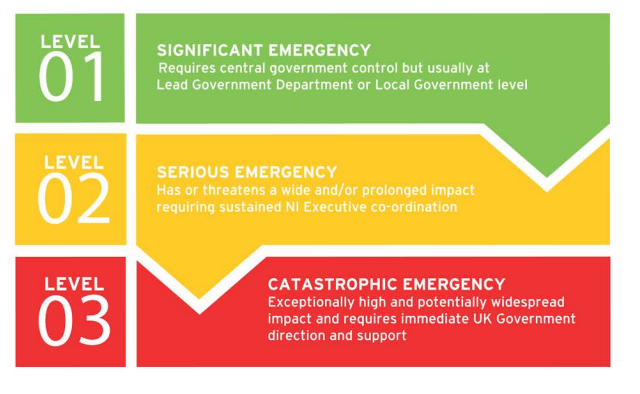
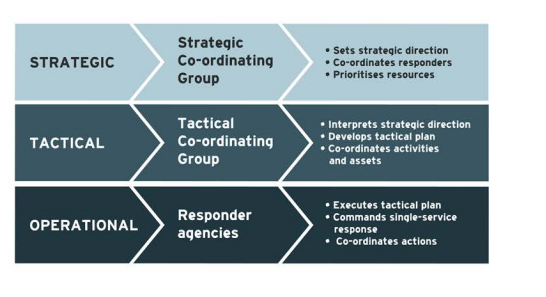
The range of emergencies a country can experience is vast and as such emergencies are classified by scale, rather than by type. The UK scales are as follows, the colour coding relates to the escalation diagram below. These scales are owned and defined by UK Government. Emergency scale levels are shown below
Coordination Levels
Devolution
The Act applies to the whole of the UK and reflects the various devolution settlements:
Part 1
Civil protection is largely devolved to Scotland. However, the Scottish Parliament consented to Part 1 of the Act being extended to Scotland. In light of this, the powers conferred on Ministers under Part 1 of the Act (power to make regulations and guidance etc.) are, in relation to devolved matters in Scotland, exercisable by Scottish Ministers. The Scottish Ministers and UK Ministers must consult each other when exercising their legislative powers under Part 1.
In Wales, UK Ministers will make legislation and issue guidance in relation to responders in Wales. However, the Act requires the UK Ministers to obtain the consent of the Assembly before taking action in relation to a responder in Wales which falls within devolved competence.
In Northern Ireland, different administrative arrangements at the local level make it impossible for Part 1 to apply to Northern Ireland in the same way as it applies in the rest of the UK. It does apply to certain bodies in Northern Ireland who exercise non-devolved functions (e.g. Maritime and Coastguard Agency, Police Service of Northern Ireland). In addition, the Northern Ireland Administration has developed the Northern Ireland Civil Contingencies Framework, which will ensure that responders falling within transferred competence act in line with the duties set out in the Act. The Framework is available at
http://cepu.nics.gov.uk/pubs/NI%20CCF.pdf
Part 2
Emergency powers are a reserved matter. However, Part 2 ensures the devolved administrations will be consulted, if emergency powers are to be used in their territory, wherever possible. It allows emergency powers to be used in Scotland, Wales or Northern Ireland alone for the first time, though the use of emergency powers remains with Westminster.
The Roles of Lead Government Departments, Devolved Administrations and Other Public Bodies
Key Legislation
Key Documents
UK Government – Core Resilience Guidance
The Civil Contingencies Act
Emergency Response and Recovery Guidance
The Emergency response and recovery guidance aims to establish good practice based on lessons identified from responding to and recovering from emergencies, both in the UK and internationally.
‘Emergency response and recovery’ is designed to complement Emergency preparedness, which sets out how the duties under the Civil Contingencies Act (CCA) — 2004 and its supporting regulations should be implemented.
The guidance aims to further develop:
- shared understanding of the multi-agency framework for emergency response and recovery at the local level, and the roles and responsibilities of individual organisations
- shared understanding of the role of local, sub-national and national levels in emergency response, and how they will work together
- a common frame of reference, especially concepts and language, for those involved in responding to emergencies
The guidance was updated in April 2010 and refreshed in July 2012 following the coroner’s report on the 2005 London bombings. The changes made to this document reflect the learning, since version 1, published in November 2005
Emergency Preparedness Guidance
Guidance on part 1 of the Civil Contingencies Act 2004, its associated regulations and non-statutory arrangements.
The Amber Book
The Amber Book (updated April 2025) is the UK government’s primary framework for managing crises and emergencies, providing a national structure for central government to coordinate responses. It replaces the old CONOPs, defining roles for the Cabinet Office and Lead Government Departments (LGD) in handling complex, concurrent emergencies.
UK Government Resilience Action Plan (2025)
Other Key Documents
- Civil Contingencies Act Enhancement Programme (CCAEP) PROGRAMME INITIATION DOCUMENT
- Emergency preparedness – GOV.UK
- Emergency responder interoperability: lexicon – GOV.UK
- Emergency response and recovery – GOV.UK
- National Resilience Standards for Local Resilience Forums (LRFs)
- The Amber Book – Managing Crisis in Central Government – GOV.UK
- UK Government Resilience Action Plan – GOV.UK
- UK National Leadership for Risk Identification, Emergency Preparedness, Response and Recovery – GOV.UK
Links
- Devolved nations | College of Policing
- Home | The Emergency Planning Society –
- UK COVID-19 Inquiry Module Reports – UK Covid-19 Inquiry
- Civil Contingencies Act 2004: a short guide (revised)
- Communicating risk guidance – GOV.UK
- Communicating with the public: the ten step cycle – GOV.UK
- ELECTED MEMBER BRIEFING NOTE Civil contingencies and emergency preparedness
- Emergency preparedness – GOV.UK
- Emergency responder interoperability: lexicon – GOV.UK
- Emergency response and recovery – GOV.UK
- Evacuation and shelter guidance – GOV.UK
- Local resilience forums: Contact details – GOV.UK
- Preparation and planning for emergencies – GOV.UK
- Preparation and planning for emergencies: Responsibilities of responder agencies and others – GOV.UK
- Risk assessment: how the risk of emergencies in the UK is assessed – GOV.UK
- The Amber Book – Managing Crisis in Central Government – GOV.UK
- The lead responder protocol – GOV.UK
- UK Government Resilience Action Plan – GOV.UK
- UK National Leadership for Risk Identification, Emergency Preparedness, Response and Recovery – GOV.UK